
REA vs Domain: Who's Really Shaping the Future of Property Marketing?
REA and Domain are still competing for listings, but that is no longer the contest that matters most to real estate creatives. Both portals are moving upstream into how property content gets created, through data, floor plans, immersive tools and AI. The real risk for photographers isn't which portal wins. It's becoming an interchangeable supplier inside someone else's workflow.
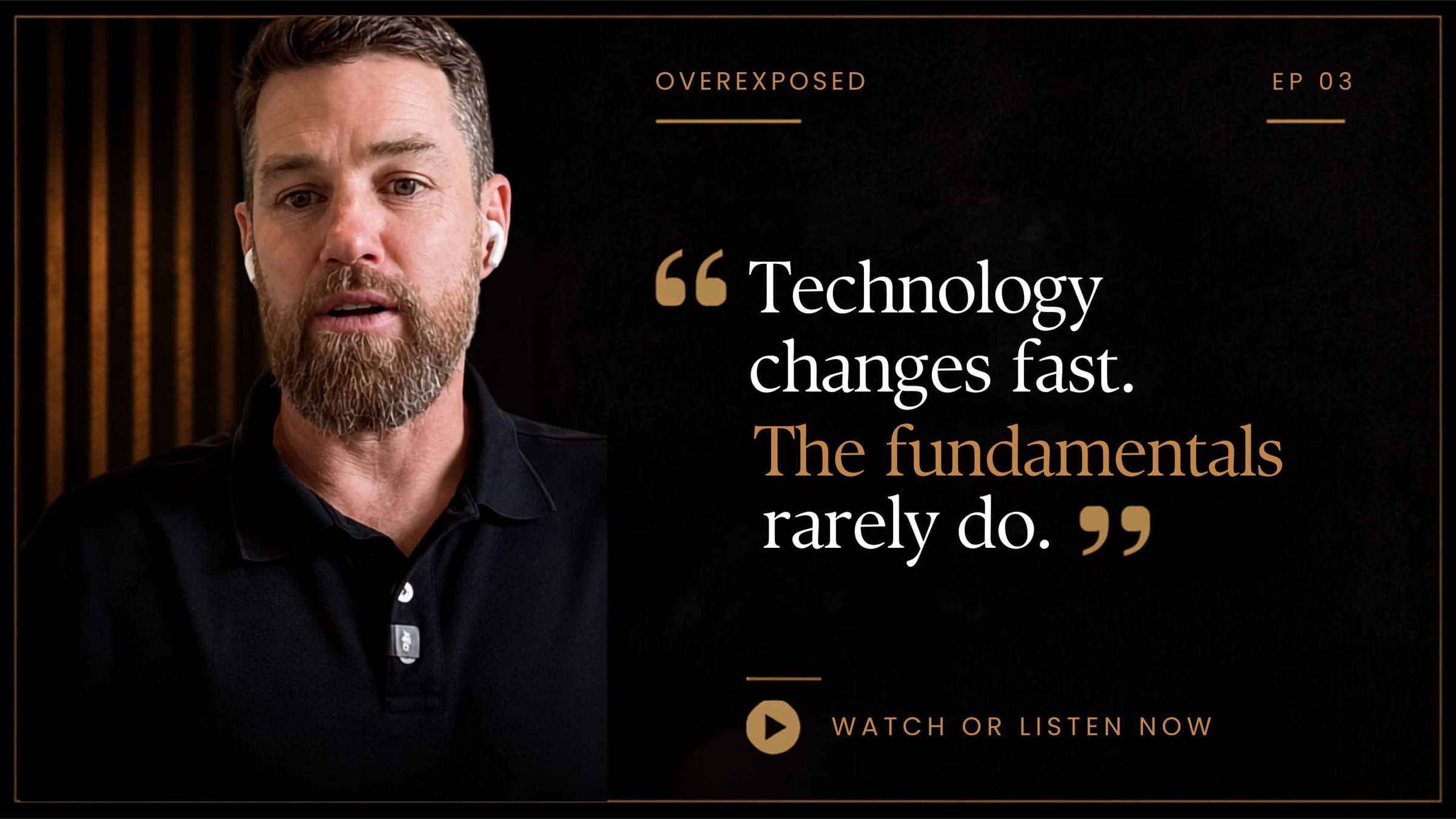
Jacqui Kirk and I unpacked this on the latest episode of Overexposed. This post is where I've landed, and what I think creative operators should do about it.
Is REA vs Domain still just a battle for listings?
No. Listings are still the core of both businesses, but the competition now reaches well beyond the listing itself.
For as long as most of us have worked in this industry, the portals have fought over three things: agents, vendors and buyer eyeballs. Our work sat on the edge of that fight. We produced the photos, video and floor plans, and the portals displayed them.
That line is blurring. Both businesses now have an interest in owning more of the property marketing process, from the moment a campaign is booked through to the tools, data and technology used to bring it to market.
Why do the portals care about how content gets made?
Because whoever controls creation controls the data, and data is the asset.
A floor plan isn't just a drawing. It carries measurements. A 3D scan carries spatial data about a property. A library of photos is training material for software that classifies rooms, scores presentation and suggests edits. Once a platform captures that at the source, it knows more about the property, the agent and the market than anyone else.
That is how I read REA's investment in technologies such as iGUIDE. It points to how much weight is now being placed on property data, floor plans and immersive digital experiences. On the other side, Domain is now owned by CoStar Group, which brings a large international player with its own playbook into the Australian market. I've written before about why CoStar's strategy isn't working in the US and won't work in Australia, and I haven't changed my view. But I'd be foolish to pretend it won't change the conversation here.
None of this is only about the consumer experience. It is about who controls the technology, workflows and creative services that real estate businesses rely on.
Where does AI fit into this?
AI makes it cheaper to produce content that is good enough, and a platform with the data and the distribution is well placed to bundle it.
Automated enhancement, virtual staging, generated listing copy and floor plans drawn from scan data all exist as tools today. Put them inside the platform where the agent already uploads the listing, and you can see how the creative step starts to look like a feature rather than a service.
I don't think that replaces good photographers. I've said as much in Will AI Take My Job In Real Estate Photography? What it does do is squeeze anyone whose only offer is producing files.
Should real estate photographers be worried?
Some should, and it depends on what your business actually sells.
If your business is a camera, a price and a turnaround time, you are exactly the kind of supplier a platform can bundle, discount or replace. The agent doesn't have a reason to choose you over whatever shows up in the portal dashboard.
If agents book you because you understand their brand, deliver a consistent standard across every campaign and help them win the next listing, you are much harder to swap out. That is the shift I keep pushing for: creatives as strategic partners, not file producers.
How do you protect your business as the platforms move in?
Own the relationship and the standard, and don't build your business on tools you don't control.
- Own the agent relationship, not the listing. The portal owns the listing. You need to own the trust of the agent and the office.
- Build a recognisable standard. Agents should be able to tell your work apart, and know every shoot will meet it.
- Keep your workflow independent. Use platform tools where they help, but don't let your booking, delivery or client data live only on someone else's terms.
- Sell the campaign, not the files. Talk about what the content does for the vendor and the agent's brand, not how many images are in the gallery.
- Have real systems. If you are the only thing holding your business together, you won't have time to adapt when the market moves.
This is a big part of why we built LUXengine. Our members' workflow, branding and client relationships sit in systems that BWRM and its operators control, not in a portal's product roadmap. Independent operators run their own businesses, but they don't have to build that infrastructure alone.
So who is really shaping the future of property marketing?
Whoever owns the relationship with the agent and the vendor. The portals shape distribution, and they will keep trying to shape creation. But creatives still shape what a buyer sees first, and how an agent's brand shows up in every campaign.
That is real influence. The question is whether you use it, or hand it over by default.
What should you do next?
Start with an honest look at your own business. How much of your work could an agent replace with a tool inside a portal dashboard? Which clients choose you for reasons beyond price? Where does your client data and workflow actually live?
Then listen to the Overexposed episode with Jacqui and me for the full conversation. If you want to build a creative business that doesn't depend on any one platform's goodwill, have a look at how BWRM works for creative operators and get in touch.
Frequently asked questions
What is the difference between REA and Domain for real estate photographers?
Both are major Australian property portals where your work is displayed, so in practice photographers produce content for both. The difference that matters now is ownership and strategy, with Domain owned by CoStar Group and REA investing in property data and immersive technology.
Will the property portals replace real estate photographers?
I don't think so, but they can make file production look like a feature rather than a service. Photographers who sell a consistent standard and a strong agent relationship are much harder to replace than those competing only on price and turnaround.
Why are property portals investing in floor plans and 3D scanning?
Because floor plans and scans carry valuable property data such as measurements and spatial information. Whoever captures that data at the source knows more about the property and the market, which is a strategic asset.
How can a real estate photography business stay independent of the portals?
Own the relationship with your agents, build a recognisable standard and keep your booking, delivery and client data in systems you control. Use platform tools where they help, but don't make your business depend on them.